hx Live NYC 2026 brought together pricing and underwriting leaders from US commercial and specialty carriers to explore how AI, workflow automation, and portfolio-level context are reshaping underwriting. This recap highlights the keynote sessions, carrier conversations, and hx announcements, including Workflow Builder and the move from assisted to governed, agentic underwriting.
By
Chris Camps
·
hx Live is hyperexponential's flagship event for pricing and underwriting leaders. The New York edition, on September 17, brought together market perspective, carrier conversations, and new hx announcements.

Across the sessions, one question kept coming up: is AI being layered onto yesterday's structure, or is underwriting being redesigned around it? This post shares a few key moments from the agenda.

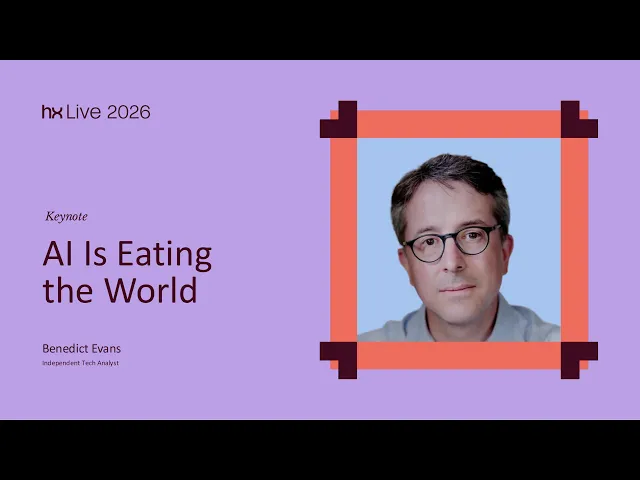
AI Is Eating the World
Independent tech analyst Benedict Evans opened the day with his keynote. After 20 years tracking the major platform shifts in tech, Benedict used that history to place AI in its adoption cycle: a new platform every 10 to 15 years, from mainframes to PCs, the web, and smartphones, and now AI, with the build phase well underway. The four biggest platform companies will spend more than $700 billion on capex this year, and the keynote's read was that the models will end up as commodity infrastructure, with value moving up the stack to what gets built on top.

For insurers, the more useful part was deployment. AI use is broad but shallow, with 50 to 60% of people saying they use it and 5 to 15% using it daily. Giving everyone a spreadsheet in the 1980s, or a browser in the 1990s, did not rebuild operations, and the same holds for giving everyone a copilot or running a handful of pilots. The keynote used an insurance office from 1960, where the whole building worked like one spreadsheet, to show that the mainframe's first step was automating the same work and the bigger changes came afterward. Where to look for them: faster and cheaper work, work that never scaled, new questions, and physical AI.
The keynote closed with three conclusions: ask what you can do with it now, ask whether it breaks something fundamental in your business model, and assume the uncertainty of 1997.
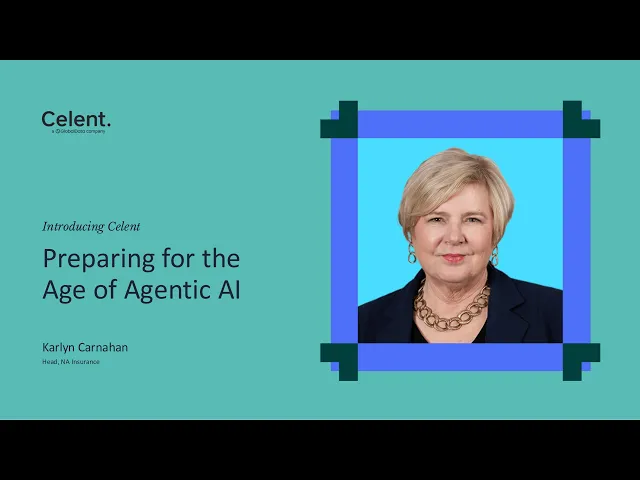
The Countdown to Agentic Insurance
Karlyn Carnahan, Executive Partner at Celent, brought the insurance view. The starting point was that earlier technology cycles delivered efficiency: more IT spend tracks with a lower expense ratio, but not with retention, growth, or loss ratio. This cycle is different because it shifts decisions, not just workflows.

Celent's research shows generative AI use in underwriting clustering around document analysis, case analysis, and submission ingestion, with far less in pricing and risk assessment. It also separates AI that improves the expense ratio from AI that changes market position, such as embedded appetite steering, continuous underwriting models, and AI-driven portfolio optimization.
Looking ahead, the session described the shift from copilot to co-worker and set out three predictions for 2026 to 2028, including that the first major AI failure in insurance will be a governance failure, not a technical one. It closed on a question for carriers: are you redesigning around AI, or layering it onto yesterday's structure?
Lessons from Recent AI Transformations
A fireside chat on real-world AI lessons brought together Kevin Hicks, AI transformation leader at Capgemini, formerly AIG, and Darren Govender, Chief Product Officer at Novacore, with hx's Kuda Chibanda, Head of Actuarial, Pricing & Portfolio Strategy. It opened with a question to the room: what does AI transformation actually mean?
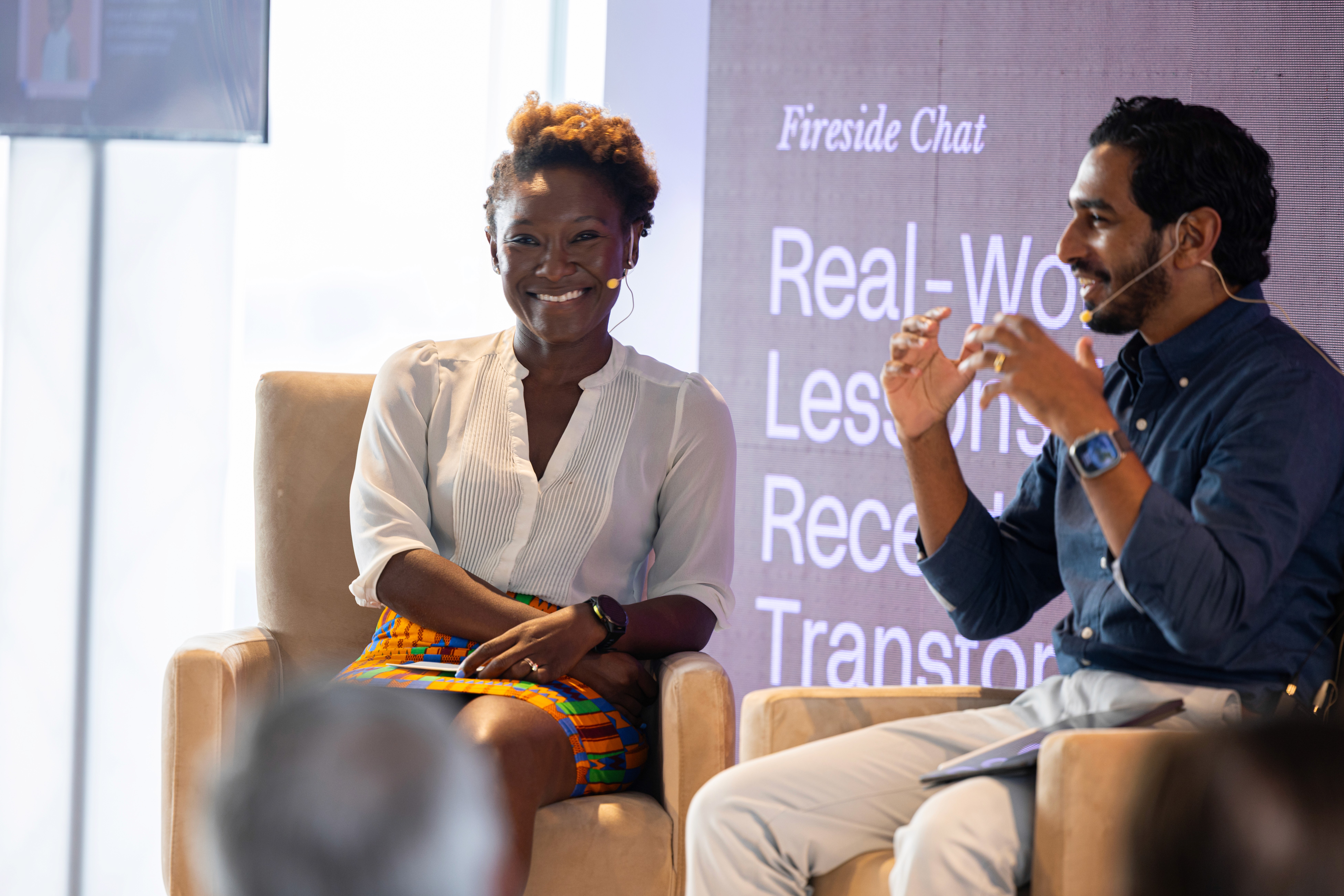
The discussion treated it as a change across people, process, and technology, not a technology rollout. For established carriers, legacy debt shows up in all three, which tends to produce bolt-on assistants within individual lines of business instead of a reimagined operation, and the cost of bolting on across dozens of lines adds up quickly. MGAs can run more experiments, since each program works like its own business, though data controls slow everyone down.
Measurement was the other thread. Capgemini's World Property & Casualty Insurance Report 2026 found that 42% of insurers track no AI metrics, and the conversation pointed to a missing baseline, and the difficulty of attributing results to AI, as reasons the impact is hard to see.

What's New from hx
Jamie Wilson, VP Strategy, opened with a simple argument: better insight on a risk loses its value if the broker waits a week for a response, and a portfolio trend spotted after it hits the bottom line is no help either.

The announcements mapped to three outcomes: speed of service, portfolio-level thinking, and deeper risk insight.
On speed, the focus was triage and quoting. An indicative technical price and desirability scores at triage put pricing and appetite signals in front of the underwriter at intake, while auto decline for risks targets the submissions that should never take up an underwriter's time. Faster ingestion through an agentic upgrade, an underwriter dashboard for all risks, and native task management support the same goal of getting to a quote in time.
On portfolio thinking, portfolio analysis across submissions, portfolio-aware dynamic benchmarking, and rates management are moving pricing decisions from single-risk judgment toward the context of the whole book. The product clips shown on stage made that shift visible, from pipeline performance by broker to rate change measured against the portfolio.
On risk insight, improvements to model comparison and policy document comparison are aimed at the analysis behind a quote. In the product clips, exposure, peril, and location detail sat in the same view as the triage steps, so full context and the complete workflow lived in one place instead of across separate tools.

Amrit Santhirasenan, CEO & Co-Founder, then framed the shift behind the announcements: from humans driving with AI assistance to AI driving with humans in control. Adam-Ben David, VP Applied AI, followed with Workflow Builder. The starting point was that generic workflow tools each capture part of underwriting, while underwriting behaves like a living graph, with some risks going straight through with no human sign-off and others staying high-touch with sign-off switched on. Teams define the workflow in Workflow Builder, and hyperoperator, the agent for underwriting work, runs it.

Kuda Chibanda and Maeve Heneghan closed the announcements with a live hyperoperator demo, run on stage across a laptop and a phone, following a rush commercial auto submission end to end to a quote.


AI-Assisted Underwriting in Practice
The final session of the day was a panel on AI-assisted underwriting in practice. Melissa McDermott, Head of Actuarial Pricing at CNA Insurance and Lisa Davis, Head of North America, Wholesale & Specialty at Everest joined moderator Maeve Heneghan, hx's Director of Underwriting Strategy & GTM.
The conversation kept returning to where AI helps most. Intake and triage are already table stakes, with decision support as the next step. hx's Underwriting Edge Report 2026 shows the same gap: among the 350 senior commercial and specialty P&C underwriters surveyed, 51% cite time saved on manual admin as AI's biggest contribution so far, while 21% report improved decision quality. Portfolio context at the point of quote could replace reporting that has traditionally arrived after the account was bound. The benefit also varies by account type: structured, high-volume risks gain most from automation, while complex and specialty risks gain from better information in front of the underwriter at the point of decision.
On what separates carriers, the panel's view was that technology will be available to everyone, so the difference comes from change management, keeping underwriters involved from the start, and redesigning workflows instead of applying AI to the old process. Underwriter judgment stayed central throughout, supported by transparency into what drives an AI output and by an apprenticeship model that AI accelerates but does not replace.

In Summary
Together, these sessions pointed to the same shift: underwriting is moving from AI layered onto existing process to work redesigned around it.
That shift depends on the whole stack working together: ingestion, triage, pricing logic, portfolio context, workflow controls, and agents, all inside one governed agentic underwriting workbench.
hyperoperator is in a controlled rollout with select customers. Register your interest.
To see it on your own submissions, book a demo.

Chris Camps