One governed workflow that holds referrals, peer reviews, and broker back-and-forth, so clean submissions clear without anyone touching them and complex ones get the review they need.
By
Alex Catterall
·
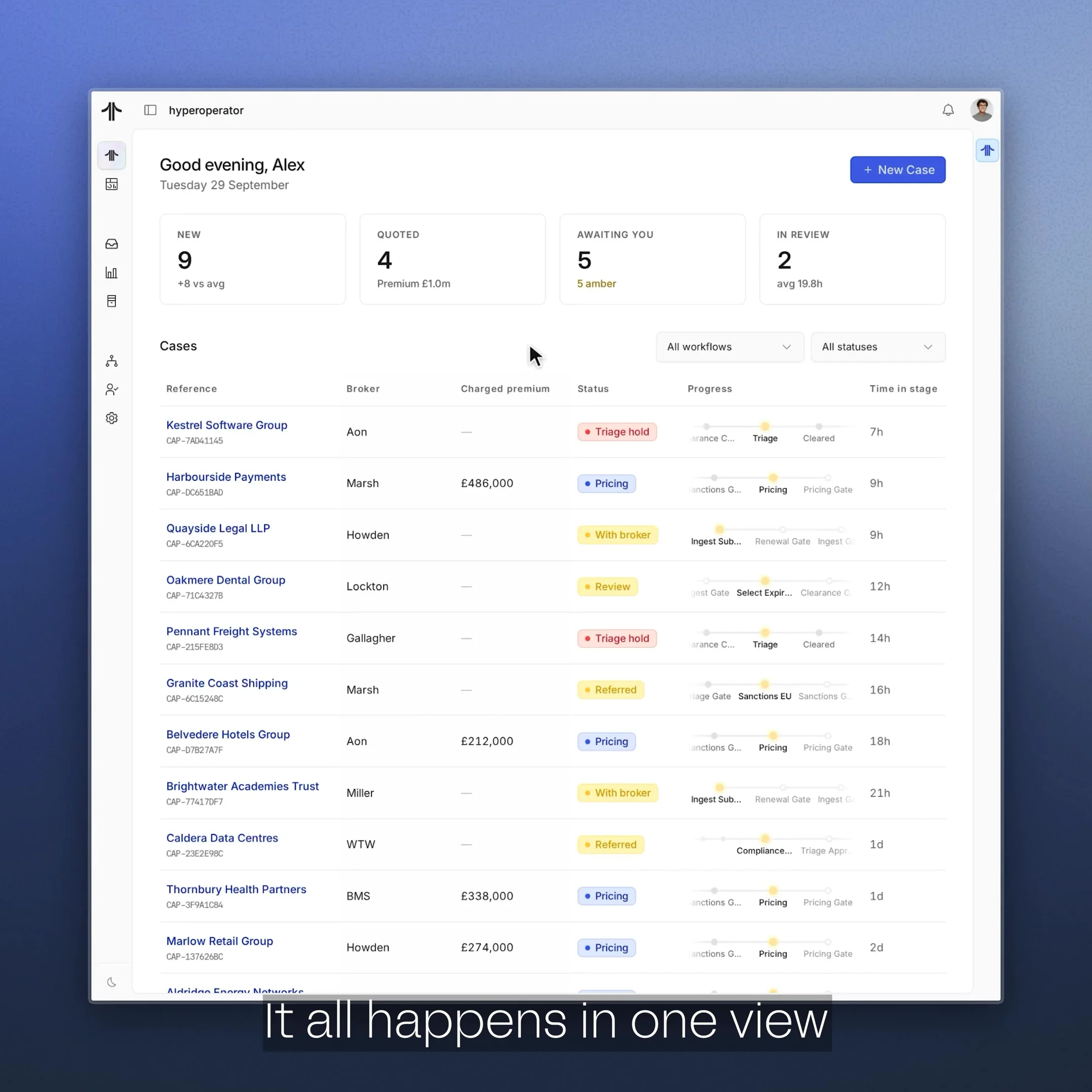
A referral goes back to triage. A peer review waits on legal. The broker changes the limit twice before anyone has quoted. How much of that does your workflow tool hold?
Underwriting never moves in a straight line, and it never happens in a vacuum. Most tools built to manage it assume both.
Three tools, one wrong assumption
Traditional workflow tools treat underwriting as a linear procedure. Intake, assess, approve, issue. Case management treats it as a file that can be picked up in any order, but it cannot hold the judgment behind the file. Data orchestration treats it as clean, derived data, when the work depends on people, exceptions, and events outside the system.
None of them were built for what underwriting is on a real desk. Broker back-and-forth, referral hand-offs, submissions re-keyed at every step. And because moving data between systems is painful, only some fields get mapped. The rest gets dropped, along with the context that should sharpen the next decision.
Teams describe the same pattern before they consolidate. At DUAL, offshore teams re-keyed the same submission data into the policy admin systems that underwriters had already typed into their spreadsheets. At RB Jones Global, reviewing a complex transaction meant pulling three or four systems and data points into a Word document: slow, error-prone, and with no audit trail.
One workflow that holds the loops
On hx, teams can build a single workflow that holds the mess. Follow one submission through it:
It arrives and clears triage. Straightforward risks move forward automatically, because the rules you set allow it.
An appetite update puts it back in scope for review, so it returns to triage rather than dropping out of the system.
Pricing raises a question for peer review, and the review pulls in legal. Both sit in the same view as the pricing work.
The broker changes the limit mid-pricing. The case reopens where it stands, and everything done so far stays attached to it.
Referral and approval happen on the same record, under the authority rules for that line.
Broker and referral admin lives in the workflow instead of in someone's inbox, so everyone on the team works from the same context. Data moves through once, and every loop feeds detail back in, so decisions get sharper instead of getting lost. Underwriters can see what a submission does to the portfolio, and how it compares to the last risk like it.
Governed at every step
Stages, rules, and review points are configurable by line of business. Routine work moves forward where the rules allow. It stops at the exact points you define, which reserves people for judgment, authority, and escalation decisions. Decision Trace captures every action, model call, and data touch with no extra instrumentation, so the reasoning behind a referral travels with it.
Governance is also what a carrier's partners ask about. Catherine Farnworth, Chief Actuary UK & Europe at DUAL, puts the outcome plainly: "One of the key outcomes for us is we're able to evidence a robust and well-governed pricing framework to our carrier partners." At RB Jones Global, underwriters are routed into hx at the point of quoting and cannot proceed without going through it, which keeps pricing at the center of the process rather than a step that gets skipped.
Referral rules and pricing logic stay in step
Workflows like these run on hx's Workflow Builder, where stages, rules, data, and review points are configurable from intake to approval, and parallel, forked, non-linear, and merged paths are a first-class part of the design rather than a workaround. Because pricing, appetite, referral, and authority logic lives in Calculation Engines and is callable from the workflow, a referral rule and the logic it refers against stay in step with each other.
Built for how underwriting actually runs
The difference is between forcing underwriting to look tidy on a slide and building for how it really moves. Underwriters get a workflow that flexes to the submission in front of them, rather than a tool that only works when nothing unusual happens.
The problem was never underwriting's workflow. The tool for it never existed. That is what the agentic underwriting workbench is: the place where insurance work gets done.

Alex Catterall
Director of Technical Delivery, hyperexponential
Frequently asked questions
What is an underwriting workflow?
It’s the steps a submission goes through, from intake to approval. In real life those steps loop back, branch, and escalate. hx’s Workflow Builder holds all of that in one place.
Can some submissions skip manual review?
Yes. Straightforward risks move forward on their own when your rules allow it. The workflow stops at the points you choose, so underwriters only handle what needs their judgment.
Can approval rules differ by line of business?
Yes. Stages, rules, and review points are set per line of business. Referral and approval happen on the same record.
Can we see who did what on a referral?
Yes. Decision Trace records every action, model call, and data touch, so the reasoning stays with the referral.
Does this replace our policy admin system?
No. The policy admin system stays the system of record. At RB Jones Global, underwriters are routed into hx when they quote. Speak to one of our pricing and underwriting experts to learn more.